"Ford will continue to provide customers in India with ongoing parts, service, and warranty support." That is Ford Motor Company's own sentence, from its 9 September 2021 release ending local car manufacturing, and the line it would rather owners stopped quoting. Read it beside a shuttered showroom and see what it leaves out: how many Ford service centres, and for how long. Owners reporting closures are not imagining a broken promise. The promise never held a number.
Key Takeaways
Ford's 2021 pledge covers parts, service and warranty for Indian owners but promises no measurable reach, so get Ford India's answer in writing.
- The duty sits with Ford, not your old dealer; a closed showroom does not end a warranty claim.
- Ford has never published how many outlets the pledge covers; confirm your nearest one in writing.
- Ford is investing in Chennai again, so money is no excuse for thin owner support.
- Price your own trip: distance doubled, divided by mileage, times fuel price.
Will Ford continue to service cars in India?
Yes, on paper: Ford's September 2021 release promises Indian customers continued parts, service and warranty support, but it commits to no measurable figure, so a workshop near your home is something Ford never actually promised you.
Ford also said it "will continue full customer support operations for these vehicles with service, aftermarket parts and warranty coverage." That puts the duty on Ford, not the franchise that stamped your service book, so write your claim to Ford India.
Worse, Ford promised to help dealers move "from sales and service to parts and service support": a licence to shrink, with nothing counted. Europe attaches duties to repair, as its EU right-to-repair directive shows, and takes sealed-battery devices off EU shelves by a fixed date. Ford's pledge reads like the draft before anyone asked for dates.
Why leave the number out? Ford's release booked more than $2 billion in India operating losses over 10 years. An exit priced on losses treats after-sales as a cost to cut, and an uncounted pledge lets it shrink quietly.
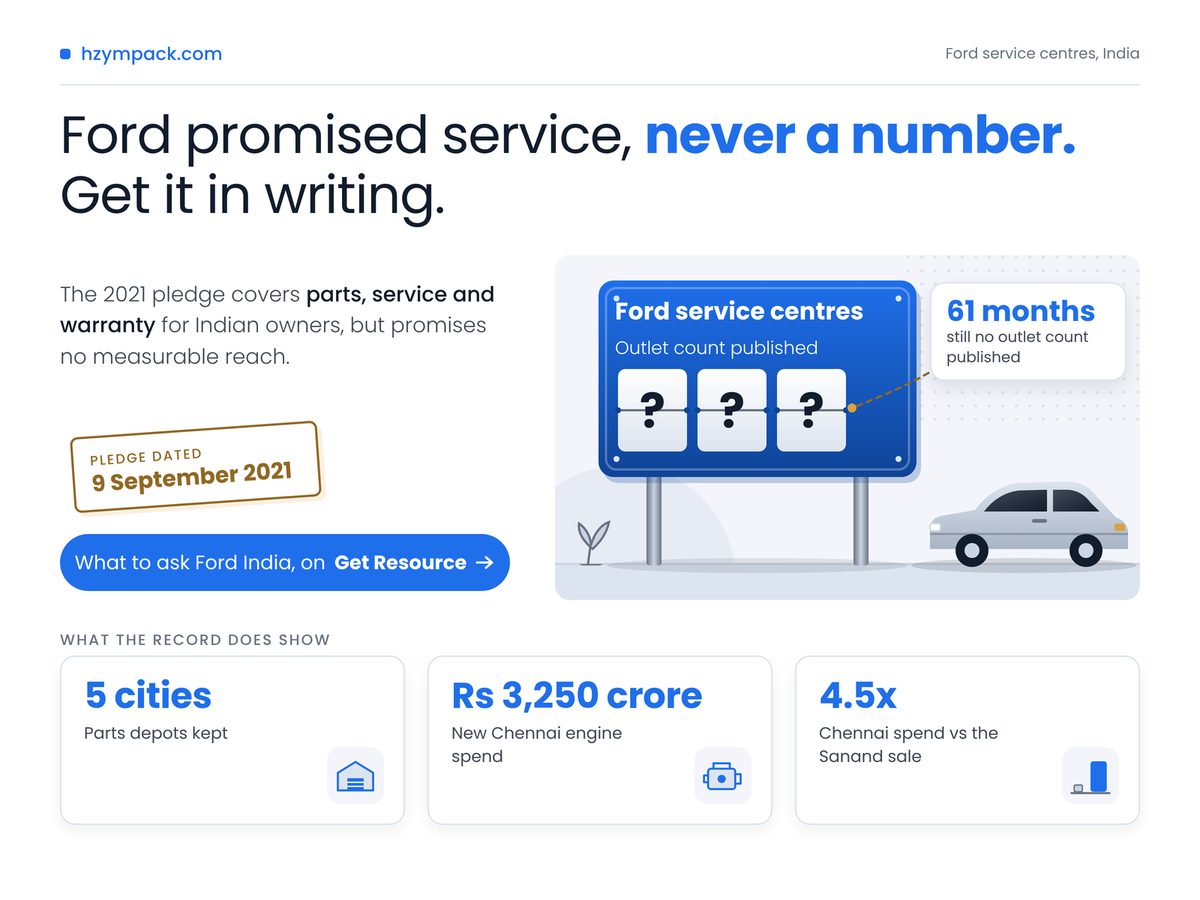
Four numbers decide whether you trust the pledge or plan around it. Ford's release gives the depots, the Government of India's IndBiz portal the Chennai investment (31 October 2025), and Tata Motors' filing of 10 January 2023 the Sanand plant price: Rs 725.7 crore, cash Ford recovered on exit. Two cards are our arithmetic.
Pledge Age, No Outlet Count
61 months
Derived; still no count published
Parts Depots Ford Kept
5 cities
Smaller towns wait for shipments
New Chennai Engine Spend
Rs 3,250 crore
Money exists; owners go unmentioned
Chennai Spend vs Sanand Sale
4.5x
Derived; reinvesting far more than recovered
The depot card reaches your driveway. Ford kept warehouses in Delhi, Chennai, Mumbai, Sanand and Kolkata, with no promised delivery time, so a car laid up in a district town waits on a metro courier.
Sixty-one months on, Ford still has not said how many workshops its promise covers. A pledge with no number cannot be broken.
Where can I service my Ford car in India now?
At whichever outlet Ford India confirms in writing as authorised today, because the company publishes no fixed count and a dealer you used before 2021 may since have stopped servicing Ford cars altogether.
Find your situation in the first column; read across for the step and why it holds.
| If you | Do this | Because |
|---|---|---|
| Dealer has shut | Ask Ford India for the nearest authorised outlet | The pledge binds Ford, not the dealer |
| Under warranty | Get any claim refusal in writing | Warranty cover is in Ford's 2021 pledge |
| Outlet 120 km away | Compare a local garage quote with the trip | Fuel alone runs about Rs 1,440 a visit |
| Nearby outlet open | Keep using it and file every job card | Job cards prove service history at resale |
Worked example: the third row's sum. Assume the nearest confirmed outlet is 120 km away (a 240 km round trip), a diesel car doing 15 km a litre, and diesel at Rs 90 a litre, our assumption. Fuel: 240 ÷ 15 = 16 litres; 16 × Rs 90 = Rs 1,440 a visit. Two services a year cost Rs 2,880 before a lost working day.
Now run yours in under a minute: double the road distance to your confirmed outlet, divide by your car's mileage, multiply by your last fuel price. If that beats the gap between the authorised quote and a local garage's, the garage wins on cost, though not always on warranty.
Ford's pledge names the kinds of help but never how much, so plan as if your nearest outlet could close. Derived from our reading of Ford's 9 September 2021 release.
Ford service centres: what the pledge leaves out
The pledge leaves out every number an owner could enforce: Ford names no minimum outlet count, no maximum distance to an outlet and no year when support ends, so a shrinking network breaks nothing Ford actually wrote.
The strongest case against Ford is its own spending. IndBiz reports the Chennai project will build 235,000 engines a year from 2029, yet Ford has not published a simple list of authorised workshops. A company building engines in Tamil Nadu cannot plead it has left India.
Our view, and it is opinion: "ongoing" ought to mean reachable. Whether a consumer commission would read a minimum reach into that word is unsettled; a pledge with no figure gives it little to measure. Europe's Cyber Resilience Act rules make connected-product makers state a support period. Ford's owners got no end date. Or rather, no date at all.
Watch for these before switching:
- A dealer's signboard is not proof it still services Ford cars.
- A part "on order" with no date is normal when it ships from a metro depot.
- Non-genuine parts fitted outside the network may give Ford grounds to refuse a warranty claim; read your terms first.
- A dealer-sold extended warranty may depend on its underwriter; find that name on your paperwork.
Check these before your next service
- Ford India has named the outlet in writing within the last month.
- Your warranty paper shows an end date still ahead of you.
- The workshop will write the part number and its expected date on the job card.
- Your round-trip fuel sum is below what a local garage saves you.
Ford wrote the pledge; make it produce a number. This week, email Ford India's customer care with your registration number and ask for the nearest authorised outlet handling warranty work. If the reply names one you can reach, stay authorised. If it cannot, that written silence is the figure the 2021 pledge never gave you, and a trusted independent garage fitting genuine parts is the better call. Under a warranty requiring authorised servicing, escalate through the National Consumer Helpline first.
How we checked this
We read Ford Motor Company's India restructuring release of 9 September 2021 line by line, and set it against the IndBiz report on Ford's Chennai engine plant of 31 October 2025 and Tata Motors' Sanand completion filing of 10 January 2023. The worked example assumes a 120 km trip each way, 15 km a litre and diesel at Rs 90 a litre. No vehicle or workshop was tested hands-on for this article. Last verified: 22 October 2026.
Edited by Shajini, reviewed after publication. Spotted something out of date? Tell us and we will correct it.